I. The Wellbore Safety Imperative Under Large-Scale CCUS Deployment
CCUS (Carbon Capture, Utilization, and Storage) is one of the key technological pathways for achieving carbon neutrality. Driven by China's dual‑carbon strategy, a number of large‑scale CCUS projects have entered the construction and operational phases, covering CO₂ capture and geological storage from multiple carbon‑emitting industries such as coal‑chemicals, thermal power plants, and steelmaking. A common feature of these projects is that large volumes of CO₂ are compressed into a supercritical state and then continuously injected through injection wells into deep saline aquifers or depleted oil‑and‑gas reservoirs for long‑term storage.
Within the risk management framework of CCUS projects, the integrity of the injection wellbore is one of the most critical safety assurance links. Once CO₂ migrates upward through sealing defects in the wellbore, it not only reduces the efficiency of carbon storage but may also contaminate shallow freshwater aquifers and even accumulate near the surface, posing safety hazards. Therefore, CCUS regulations in various countries generally impose strict requirements on the sealing integrity of injection wells, including periodic monitoring of annular pressures, verification of cement sheath integrity, and detection of tubular leakage.
However, the operating conditions of CCUS injection wells differ significantly from those of conventional oil‑and‑gas wells. The unique physical and chemical properties of CO₂ introduce a series of distinct technical challenges for wellbore integrity monitoring. Understanding the nature of these challenges is a prerequisite for selecting an appropriate monitoring technology solution.
II. Monitoring Difficulties Arising from the Special Operating Conditions of CO₂ Injection Wells
The technical difficulty of monitoring CCUS injection wellbores originates from fundamental differences in the physical properties of CO₂ fluid compared to conventional hydrocarbon fluids. These differences manifest in several aspects.
Challenge 1: Dissolution and Swelling Effects of Supercritical CO₂
Under injection conditions, CO₂ is typically in a supercritical state (temperature above 31.1 °C and pressure above 7.38 MPa), exhibiting a liquid‑like density and a gas‑like viscosity. Supercritical CO₂ has strong dissolution and swelling effects on elastomeric sealing materials (such as packer elements and O‑rings in tubing connections), accelerating the ageing degradation of seals. This implies that in CCUS wells, the degradation rate of sealing components may be much faster than in conventional natural‑gas wells, requiring higher monitoring frequencies and greater sensitivity.
Challenge 2: Thermal Stress Cycling Induced by Low‑Temperature Effects
During the downward flow of CO₂ from the surface to the bottomhole, the Joule‑Thomson expansion effect causes significant cooling in the wellbore. At the start of injection and during intermittent injection, the wellbore temperature repeatedly undergoes sharp drops followed by rebounds, creating cyclic thermal stresses among the tubing, cement sheath, and formation. This thermal stress cycling is an important mechanical factor that induces micro‑cracks in the cement sheath, loosening of tubular connections, and other sealing defects. It also makes leakage channels exhibit a "transient open‑close" dynamic behavior, further increasing detection difficulty.
Challenge 3: Complex Leakage Pathways Through Multiple Annuli
CCUS injection wells typically have multiple casing strings, forming several annular spaces such as Annulus A, Annulus B, and beyond. CO₂ gas may migrate along multiple pathways: leaking from the tubing into Annulus A, migrating from Annulus A through the cement top into Annulus B, or even moving from deeper annuli to shallower ones. The diversity of leakage pathways makes it difficult to identify the source and path of leakage solely through annular pressure observations; a monitoring method capable of continuous spatial positioning over the entire wellbore depth is required.
Challenge 4: Weak Signal Characteristics of Low‑Rate Leakage
In many CCUS injection wells, early‑stage leakage occurs at very low rates, with gas flow possibly only a few millilitres per minute or even less. Such minute leakages fall below the detection thresholds of conventional monitoring methods (e.g., pressure gauges, conventional noise logging) and are difficult to identify effectively. However, if not detected in time, these small leakages, under the combined effects of long‑term CO₂ dissolution‑corrosion and thermal stress cycling, can gradually expand into larger leakage pathways. Therefore, CCUS wellbore monitoring demands significantly higher detection sensitivity than conventional oil‑and‑gas wells.
III. Suitability Analysis of Distributed Fiber Optic Sensing as a CCUS Monitoring Solution
In response to the above technical challenges, distributed fiber optic sensing technology demonstrates strong adaptability. The following analysis highlights its technical advantages from several core dimensions.
Continuous Spatial Sensing Capability
DTS (Distributed Temperature Sensing) and DAS (Distributed Acoustic Sensing) systems achieve continuous spatial measurements along the fiber at meter‑level or even sub‑meter resolution, effectively deploying thousands of virtual sensors along the wellbore. For scenarios with uncertain leakage pathways such as multi‑annulus migration, there is no need to pre‑determine where leakage might occur; the fiber can acquire temperature and acoustic field information across the entire wellbore in a single run, automatically identifying anomalous depths from the massive dataset. This feature is particularly important for CCUS wellbore monitoring, because the diversity of leakage paths makes fixed‑point monitoring strategies less effective.
Dual‑Parameter Fusion of Temperature and Acoustics
The thermal effects and acoustic effects generated by CO₂ leakage can be captured by DTS and DAS, respectively. DTS is sensitive to Joule‑Thomson temperature anomalies caused by leakage, while DAS is sensitive to turbulent and throttling noise produced by leakage. The cross‑validation of these two parameters in space significantly improves the reliability of localization results. Especially under CCUS conditions, where leakage channels may exhibit dynamic "open‑close" behaviour, simultaneous observation of both parameters allows complementary anomalous signals to be captured at different time windows.
Intrinsic Safety and Long‑Term Stability
Silica‑based optical fibers are non‑conductive and generate no electrical sparks, fully meeting intrinsic safety requirements in the high‑pressure CO₂ injection environment. At the same time, fiber optic sensing systems can achieve 7×24‑hour continuous monitoring in unattended mode, with data automatically uploaded to cloud platforms via intranet or extranet, making them suitable for long‑term monitoring during the operational life of CCUS projects. For permanent fiber‑optic‑behind‑casing installations, the monitoring system can cover the entire lifecycle from injection operation to post‑closure storage.
Flexibility in Excitation Methods
For low‑rate leakages, fiber optic monitoring systems can be combined with various excitation methods to enhance signal characteristics. For example, well shut‑in and opening operations can change the thermodynamic state of the wellbore, and staged venting of annuli can alter pressure differentials between tubulars and annuli, forcing concealed leakage channels to generate identifiable temperature and acoustic anomalies. This combined strategy of passive monitoring plus active excitation is an effective methodology for addressing low‑rate leakage detection in CCUS wellbores.
IV. Engineering Practice Validation: A Case Study of Annular Leakage Localization in a CCUS Injection Well
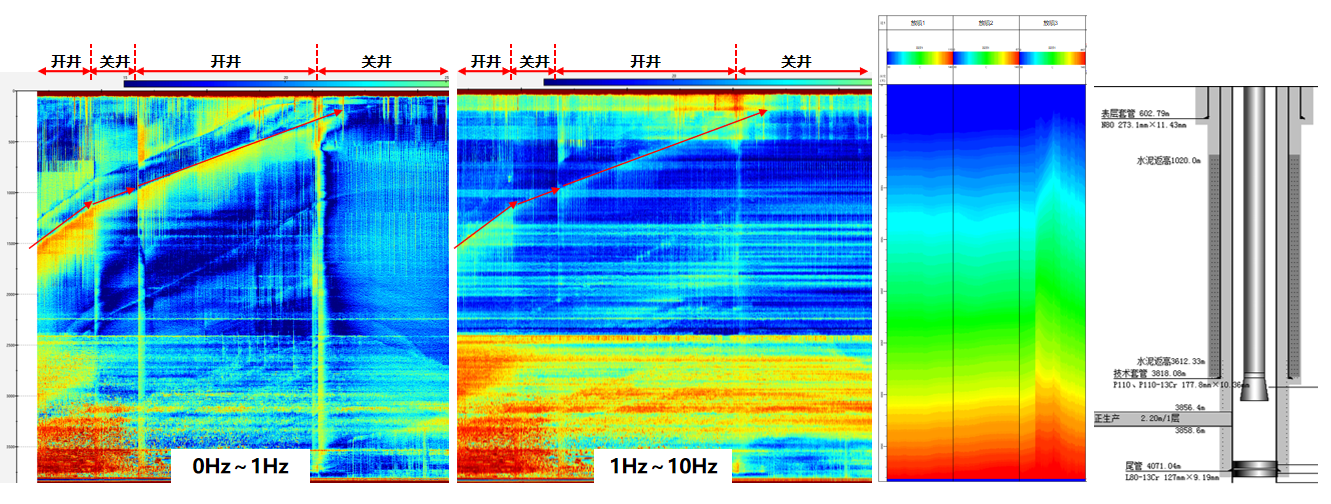
A CO₂ injection well in a CCUS project at an oilfield in Liaohe, with a depth of 4,053 m, exhibited B‑annulus pressure reaching 5 MPa with rapid pressure recovery after multiple venting operations, indicating the presence of a persistent leakage channel. On June 10, 2026, a fiber optic logging campaign was carried out using the ZhiTeng Microelectronics fiber optic logging solution, employing a free‑fall deployment technique combined with DTS+DAS combination logging to diagnose wellbore leakage.
The key to the test lay in the design of the excitation strategy. Because leakage channels in CCUS injection wells may exhibit dynamic changes under varying temperature and pressure conditions, a single venting operation might not be sufficient to excite clear signals. The technical team adopted a staged venting excitation scheme: first, a shut‑in and opening operation was performed to alter the wellbore thermodynamic state; then, multiple staged venting cycles of the annulus were conducted, with each venting incrementally increasing in amplitude to progressively enhance the fluid activity strength through the leakage channel.
During the third venting operation, the DAS FBE (Frequency‑Band Energy) waterfall plot exhibited a significant high‑energy response at a depth of 1,520 m, with clear signals across all frequency bands. The DTS data at the same depth also showed a corresponding temperature anomaly. The simultaneous response of both parameters at this location confirmed the existence of a cement‑top leakage channel from Annulus A to Annulus B at 1,520 m.