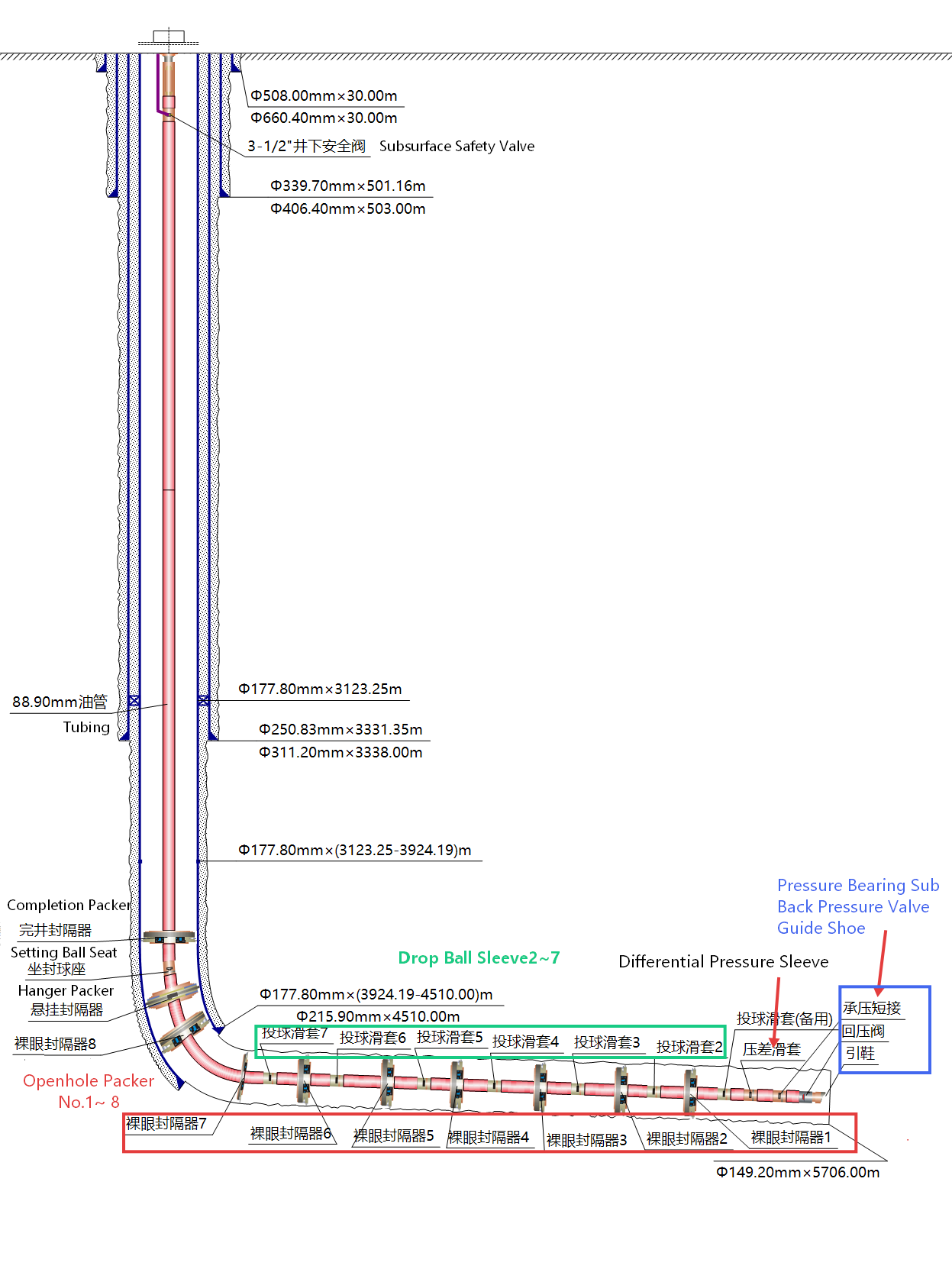
Case: Slow/Minor Leak Localization
Mar 05, 2026
1. Core Issue: Identification of Micro-Leakage
Observation: Only 1.5 m³ of fluid was injected over 4 hours under a high pressure of 40 MPa.
Interpretation: The extremely low injection efficiency observed under high pressure confirms the presence of micro-leaks in the wellbore. The fluid is being lost through minor leaks in the tubing string rather than entering the target zone.
2. Detection Methodology and Findings
3. Diagnosis of Leak Cause
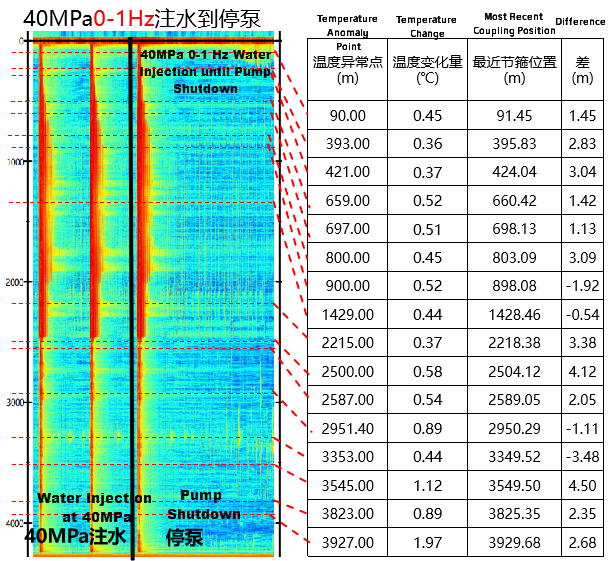
Observation: Comparison with tubing string data revealed a strong correlation between the DTS temperature anomalies and tubing collar depths.
Interpretation: By mapping the 16 anomaly depths against known tubing collar (connection) depths, a near-perfect match was found. This diagnoses the root cause as seal failure at the threaded ("pin & box") connections, allowing micro-leakage under pressure.

4. Supplementary Analysis and Key Notes
Observation: Points highlighted in red in the table showed relatively stronger DAS energy. However, under micro-leak conditions, this energy intensity is influenced by multiple factors like fracture geometry and does not show a direct positive correlation with the magnitude of temperature change.
Interpretation: The report notes that a stronger DAS signal does not necessarily indicate a larger leak or greater temperature change in micro-leak scenarios. The leak paths (e.g., thread gaps) are tiny and intricate. DAS signal strength is affected by various flow dynamics (turbulence, impingement), explaining why acoustic energy (DAS) and temperature change (DTS) are not proportionally related. This complexity further supports the diagnosis of subtle thread leaks.
5. Summary and Conclusions
| Item | Conclusion |
|---|
| Issue Nature | High-pressure micro-leaks in the tubing, causing poor injection efficiency. |
| Leak Count | 16 confirmed leak points identified. |
| Leak Location | Primarily concentrated at tubing collars (threaded connections). |
| Root Cause | Micro-leakage due to seal failure at tubing threads. |
| Diagnostic Technology | Integrated analysis using DTS (temperature) & DAS (acoustic) fiber-optic logging, providing mutually verified results. |
| Technical Insight | The lack of a positive correlation between DAS energy and DTS temperature change under micro-leak conditions reflects the complexity of the seepage pathways. |
Recommended Action: Based on this report, the operator should repair or replace the specific tubing collars corresponding to the identified anomalies to eliminate the micro-leaks and restore injection efficiency.